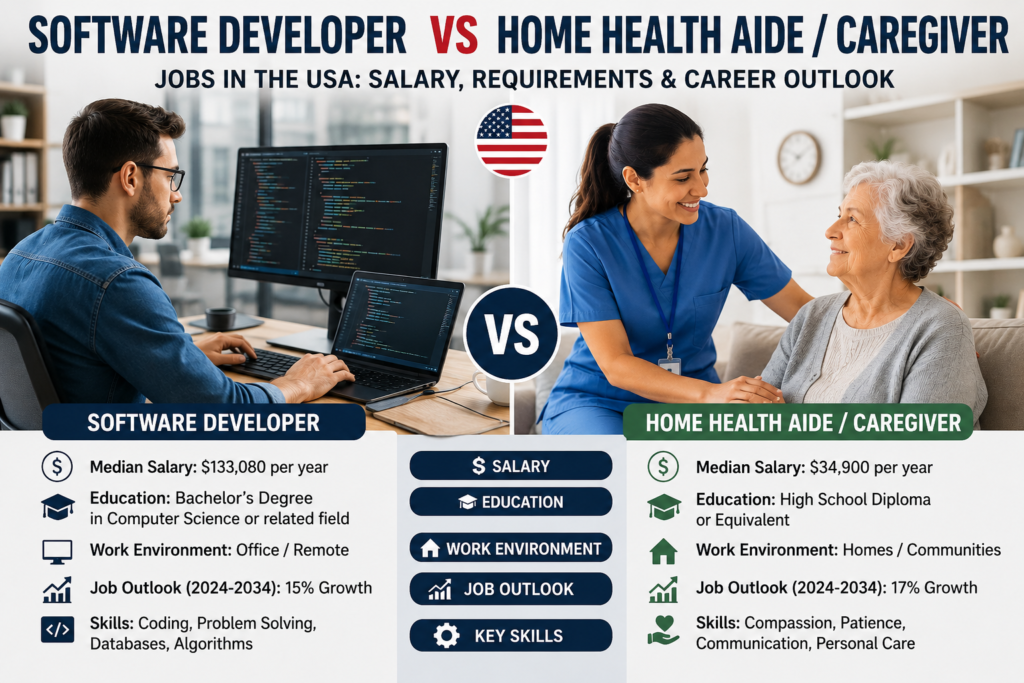
If you are looking for a healthcare job in the United States that does not necessarily require a college degree, Home Health Aide (HHA) and Personal Care Aide (PCA) jobs can be an option worth exploring. These workers help older adults, people with disabilities, and people with chronic illnesses with everyday activities while allowing them to remain in their homes or community settings.
According to the U.S. Bureau of Labor Statistics (BLS), employment of home health and personal care aides is projected to grow 17% from 2024 to 2034, much faster than the average for all occupations. The BLS also projects about 765,800 openings per year, on average, over that period.
Important: Job requirements, training, background checks, and duties can vary by state and employer. Always verify requirements with the employer and the relevant state authority before applying.
What Is a Home Health Aide?
A Home Health Aide (HHA) provides non-medical assistance to people who need help at home. Depending on the position, an aide may help a client with activities such as:
- Bathing and personal hygiene
- Dressing and grooming
- Walking and mobility
- Preparing meals
- Light housekeeping
- Shopping or errands
- Companionship
- Reminders for scheduled medications
- Reporting changes in a client’s condition to the appropriate caregiver or supervisor
Home health and personal care aides may work in private homes, group homes, residential care settings, or community programs.
Home Health Aide vs. Caregiver
The terms caregiver, home health aide, and personal care aide are sometimes used interchangeably, but they are not always identical.
A caregiver may provide general assistance and companionship, while an HHA may have additional training or duties depending on the employer and state. Some healthcare-related tasks may require specific training or authorization.
Therefore, applicants should carefully read the job description rather than assuming that every caregiver position has the same requirements.
How Much Does a Home Health Aide Make in the USA?
According to the BLS, the median annual wage for home health and personal care aides was $34,900 in May 2024, equivalent to a median hourly wage of about $16.78. The actual wage can be higher or lower depending on location, experience, employer, schedule, and type of care provided.
The BLS reports that the highest-paid 10% of workers in this occupation earned more than $44,190 per year in May 2024.
What Can Affect Your Salary?
A caregiver’s pay may depend on:
- State and city
- Full-time or part-time schedule
- Overnight or weekend shifts
- Experience
- Employer
- Type of client
- Required training or certification
- Home-care agency versus another care setting
Because wages differ considerably between locations, applicants should check current local job listings before deciding where to apply.
Are Home Health Aide Jobs in Demand?
Yes. Home health and personal care aides are among the occupations with particularly strong projected demand.
BLS data shows approximately 4.35 million home health and personal care aide jobs in 2024, with employment projected to reach approximately 5.09 million by 2034. That represents projected growth of 17%.
The aging U.S. population and increasing demand for care delivered in homes and community settings are among the factors supporting employment growth in this field.
What Qualifications Do You Need?
One reason this career attracts job seekers is that the education requirement can be relatively accessible.
The BLS says home health and personal care aides typically need a high school diploma or equivalent, although some positions may not require one. Workers employed by certified home health or hospice agencies may need formal training or to pass a standardized test.
Requirements can differ by:
- State
- Employer
- Type of care
- Whether the agency is certified
- Specific job duties
Before paying for a course, check whether the employer and state actually require that credential.
Important Skills for Caregiver Jobs
A good caregiver needs more than physical ability. Employers may also look for:
- Patience
- Communication skills
- Reliability
- Compassion
- Time management
- Attention to detail
- Ability to follow instructions
- Respect for client privacy
- Basic problem-solving skills
BLS notes that interpersonal skills, adaptability, and being detail-oriented are important characteristics for these workers.
Where Do Home Health Aides Work?
Home health and personal care aides can work in several environments, including:
Private Homes
Many aides provide care directly in a client’s home. This can allow clients to remain in a familiar environment.
Home Healthcare Agencies
Agencies hire aides and assign them to clients based on their needs and schedules.
Assisted Living and Residential Care
Some aides work in residential settings or care communities rather than individual homes.
Community Programs
Other positions can involve group homes or day-service programs.
Home Health Aide Work Schedule
The schedule depends heavily on the client and employer. Full-time work is common, but part-time positions are also available.
Some jobs may include:
- Morning shifts
- Evening shifts
- Weekend work
- Overnight shifts
- Split schedules
- Several clients during a week
Anyone applying for a position should ask about the exact schedule, minimum hours, overtime policy, transportation requirements, and whether the position involves live-in care.
How to Find Home Health Aide Jobs in the USA
A practical job search can start with legitimate employer websites, established job-search platforms, and state employment resources.
When searching online, useful phrases include:
- Home Health Aide jobs near me
- Caregiver jobs in USA
- Home care jobs hiring now
- Personal Care Aide jobs
- Entry-level caregiver jobs
- Home health aide jobs no experience
- Caregiver jobs with training
- Senior caregiver jobs
- Private home caregiver jobs
- Home care agency jobs
Instead of applying to every advertisement you see, compare the employer, job duties, location, pay, schedule, and requirements.
Can You Get a Caregiver Job With No Experience?
Some entry-level positions may accept applicants without previous professional caregiving experience, particularly when the employer provides training.
However, “no experience required” does not mean “no requirements.” Employers may still require background checks, references, basic qualifications, health-related documentation, driver’s license, or specific training depending on the job.
Read the complete job description before applying.
Home Health Aide Job Scam Warning
Job seekers should be especially careful with online caregiver advertisements.
The Federal Trade Commission warns that scammers sometimes create fake caregiver and nanny job advertisements. One common scam involves sending a fake check and asking the worker to deposit it and send some of the money elsewhere. A legitimate employer should not require you to send money back from a check they provide.
Be cautious if a recruiter:
- Guarantees an unusually high salary for very little work
- Asks you to pay money to get hired
- Requests gift cards
- Sends a check and asks you to return part of the money
- Requests sensitive financial information before you have verified the employer
- Contacts you unexpectedly through WhatsApp, Telegram, or text and immediately offers a job
The FTC’s guidance is simple: never pay money to get a job and research the company before providing personal information.
Frequently Asked Questions
Is Home Health Aide a good career in the USA?
It can be a suitable career for people who enjoy helping others and want to enter the healthcare support field without completing a four-year college degree. Demand is projected to remain strong through 2034.
How much does a home health aide earn per hour?
The BLS reported a $16.78 median hourly wage for home health and personal care aides in May 2024. Actual wages vary by location and employer.
Do you need a college degree to become a home health aide?
Generally, no. BLS states that a high school diploma or equivalent is typically required, although some positions do not require it. Additional training may apply to certain jobs.
Are caregiver jobs available for beginners?
Some employers offer entry-level positions or training, but requirements vary. Always check the individual vacancy rather than assuming that every caregiver job has the same requirements.
Is a caregiver the same as a nurse?
No. A caregiver or home health aide generally provides personal care and assistance with daily activities. Nurses are licensed healthcare professionals with different education, responsibilities, and scope of practice.
Final Thoughts
Home Health Aide and Caregiver jobs in the USA can be an attractive option for people interested in care work and looking for an occupation with substantial projected employment demand. BLS projects 17% employment growth from 2024 to 2034 and approximately 765,800 openings annually for home health and personal care aides.